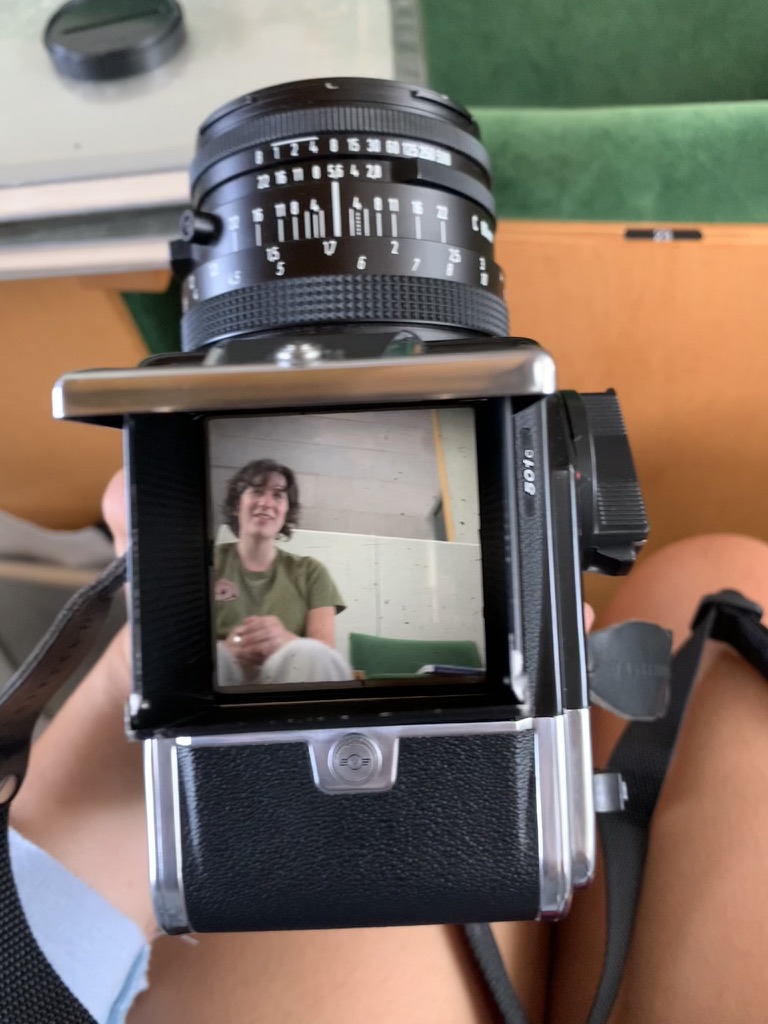
At first, choosing my camera as my object felt obvious. It’s something I use all the time, and it clearly represents my interest in photography. While taking 205, I was also in the documentary photography class Photo 3. Thus, I always had it on me anyway. On the surface, it’s just an expensive tool I use to document people and places that matter to me. It is a Nikon Z6 that I worked for a summer to buy. Upon reflection, I realized it also shapes how I see and interact with the world. When taking pictures, I’m deciding what to include and what to leave out through framing. This process is subjective. The image unescapably reflects my perspective as much as it reflects the subject. In Claire Grace’s class, Art after 1945, we also discussed how the photograph is an index of light and time on the page. The photograph is a mark of material evidence of the time. The choice to shoot digital, to record the most pixels, for documentary projects, is also a record of the technology of our time.
This connects to what we’ve talked about in class in terms of representation and perspective. The camera doesn’t just document it shapes how culture is seen. That made me think more critically about the images I take and the ones I consume. Who is behind the camera? What are they choosing to show? What’s missing?
I also started to see how my interest in photography connects to broader cultural values in the U.S., especially around media and consumption. We’re constantly surrounded by images, and there’s a strong emphasis on documenting and sharing experiences. I am a part of that via Instagram, shared iPhoto albums, etc. I like capturing moments and holding onto them, but I’m also participating in a culture that monetarily values visibility and presentation. I thought about this a lot when commissioned to photograph my first wedding and was given inspiration pictures from Pinterest to recreate.
At the same time, not everyone has the same access to photography or the same relationship to it. For some people, being photographed is unwanted due to misrepresentation or conscientious refusal. Here, I am thinking of Hong Kong’s white paper or umbrella movements. In Photo 1, we were encouraged to take photos of Middletown residents caught off guard, thinking we could expose some truth. I was shocked when a student put a picture of a homeless man on the board, and expected it to have political weight. Often, people with a professional photography education still don’t consider subjects or politics of photography beyond technical excellence. I wish photographs considered positinality and their own photo-making process itself, and not what themes the photo can maybe “stand in for”.
This assignment was the beginning of my realization that my camera, beyond me holding it, isn’t neutral. It reflects a larger cultural visual language in addition to my choices, my interests, and my assumptions about what is worth capturing. That shift occurred by breaking the object down layer by layer and questioning what it represents beyond its surface, per the onion assignment’s request. Additionally, my digital camera reads as professional, and the prints have more value than iPhone prints, fortunately or unfortunately. There is a power in wielding the object. I still see photography as a form of creative expression, but I’m more aware now of the responsibility that comes with it.
Onion Object Assignment. September 8th, 2023:
1) Describe what it is if that’s not immediately evident and what it means to you. (first layer).
My Camera
2) Then take it a level deeper and explain why it is important to you; what does it signify to you (second layer)?
Signifies my love of the medium and documentation.
3) And finally, dig even deeper and identify some kind of belief, assumption, value, that you have that speaks to an aspect/multiple aspects of your own culture (third layer).
I love art and photography is a big part of media and consumerism, all things crucial to American society.