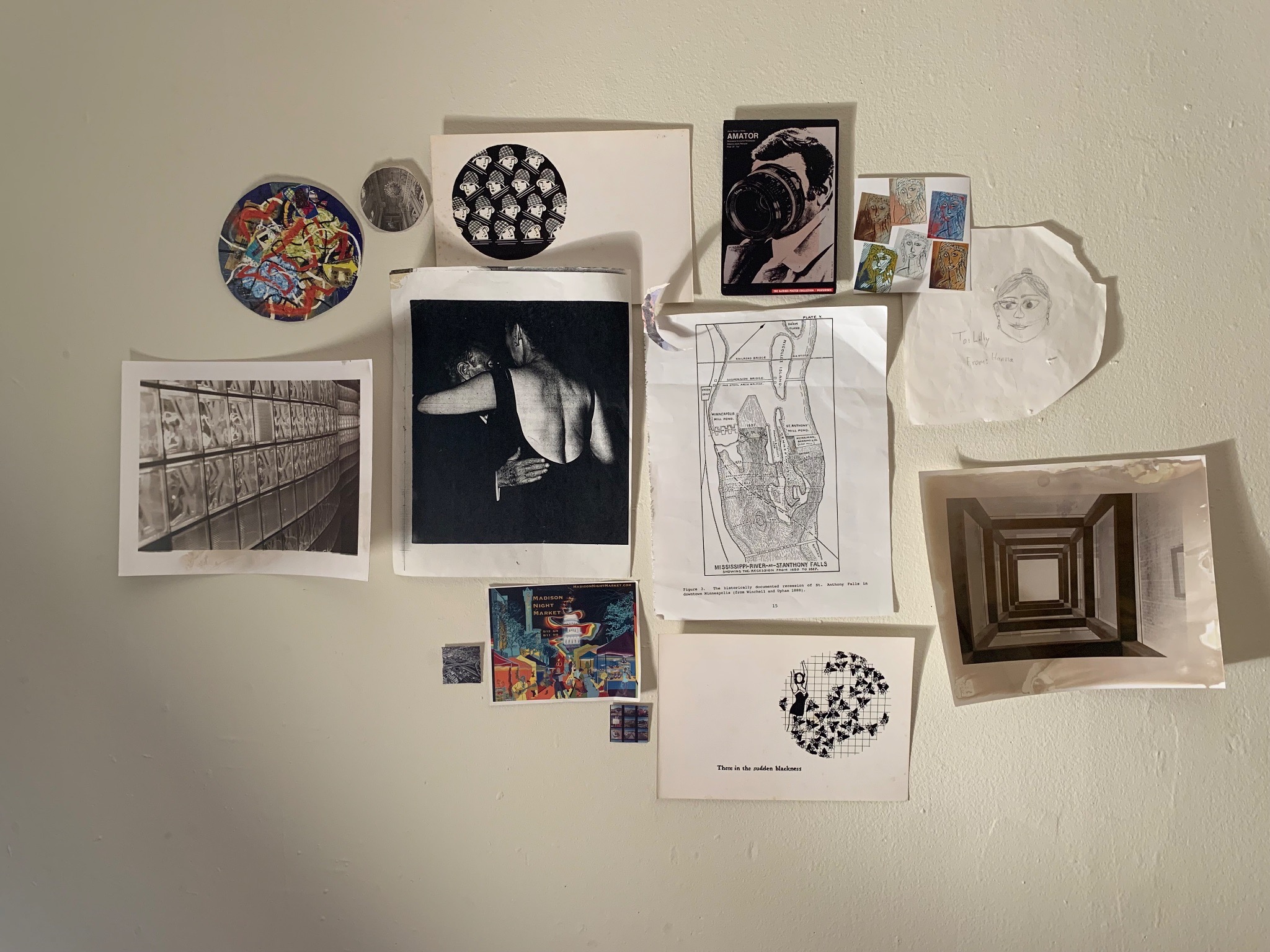
Making my cultural self-portrait forced me to think about my identity in a more representational way than I usually do. Instead of using language to describe myself with nouns, I had to choose images that actually represent or serve as evidence for various parts of my life I deem worthy. I realized we do this all the time as college students in temporary housing without funds for frames. In fact, posters are mass-produced for college students. It is wholly possible to have prints on your wall and not have an auratic attachment to them, as Benjamin would call it.
A lot of the images I included relate to where I grew up, the Midwest. The map of the Mississippi River stands out to me because it represents time spent canoeing and camp counseling, and it’s where I developed a strong connection to my environment. This love is more for the idea of the Mississippi’s majesty than for swimming in it. It is known for being the “muddy Mississippi”. I don’t think I would care as much about my city if I hadn’t grown up with riverboats and jazz, honoring the history of the Mississippi. I remember learning to spell Mississippi with my class, and feeling proud of the river. I now have a map of the Turkey River on my wall, an offshoot of the Mississippi. I had brought the map with me on a canoeing trip I led, and the sign marking the campground point had been washed away. I missed the stop and had the 10 13-year-old kids keep canoe-ing an extra 4 hours. For me, maps are an analog reminder to pay attention to our surroundings.
The photos I took on my dad’s film camera, especially the one at O’Hare Airport, represent a different kind of transition. That image captures what I see when leaving and coming back home. It also reflects how important art photography is to me. I tend to process experiences visually, and taking photos is one of the main ways I make sense of change.
Including the drawing from a camper at the Lutheran summer camp was also important. That experience connects to both my faith and my interest in working with kids. Being Christian is part of my identity, but it’s something I usually think about in terms of midwestern community specifically and belief structure. That’s something this assignment made clearer to me.
The collage also includes music and writing, like the jazz postcard and pages from a poetry book. Those represent how I connect to art and how I see myself. Identity is selected and curated, like the images in this assignment. Someone looking at it might get a very specific version of who I am, or find the images unintelligible. This made me realize how selective self-representation can be as constructed and not fixed, which we discussed in class and applied to freshman year at Wesleyan.
Cultural self portrait, october 25th, 2023:
For this assignment, I made a collage with images that represent aspects of my identity. I decided to focus on assets through my own photographs and images that spoke to me. I included photographs I had taken on my Dad’s film camera of O’Hare airport in Chicago on my way to Wesleyan. I am a photographer, and a midwesterner. I am a visual learner who enjoys seeing people and locations creatively. I also included a postcard of Jazz night in Madison Wisconsin. I love music and playing keys, as well as the surrounding areas of my home. In addition, I put a map of the Mississippi river where I grew up playing, canoeing and camping. I am passionate about preserving our rivers and learned to care about the environment through access to the river. In addition I put up pages from a poetry book. I love to read and write and want to go into publishing. I also included a picture drawn of me by a camper I had at a Lutheran summer camp that was very important to me. I enjoy working with children and identify as a Christain. The other printed images are bits of color I enjoy, postcards that have been given to me by family and friends I love and a famous photograph by Dianne Arbus that was up in my home as a kid.