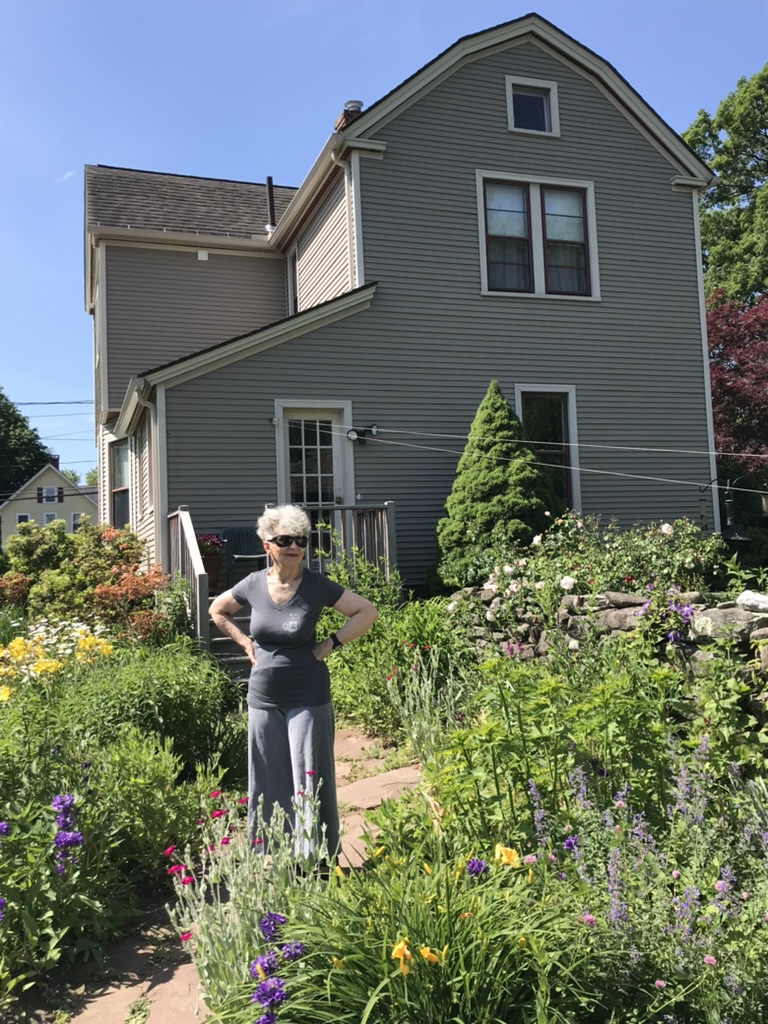
Today Phyllis is still my best Middletown friend. I have grown in my Wesleyan four years with her in the periphery. She will host my parents when they visit for graduation, as she had hosted my Dad for a year when he went to school at Wesleyan. While not engaging with her on my own enough, she is a necessary link between my education and values, and my family and home. Despite the different positionalities of my father and I, she was originally my father’s friend from when he went to Wesleyan in the 90s. She has served the purpose of Middletown-progressive-friend for two generations. Writing about Phyllis made me reflect on what I actually value in intercultural engagement and why I responded so strongly to her as a person. At first, I focused mostly on describing her elegance, intelligence, and knowledge. I realized while writing, though, that what I admire is less about how much she has seen and more about the way she approaches the world. She pays attention carefully and treats people, art, and culture with seriousness and respect for their history, and their present. The process of writing this reflection helped me understand that intercultural competence is not just about exposure to different cultures, but about how someone chooses to engage with culture and their home. Before this assignment, I think I associated being “worldly” mainly with travel, education, or knowledge. Phyllis certainly has those things—she has traveled widely, studied extensively, and collected art and experiences from around the world. That awareness connects to the GEM learning goal of developing intercultural competence through openness, active listening, and reflection. Writing this also pushed me to think more critically about privilege and access. Initially, I romanticized many aspects of her life: the travel, the education, the art, and the sophistication she carries herself with. As I reflected more deeply, I realized that many of the opportunities that allowed her to become so globally engaged were shaped by privilege. Her ability to attend Harvard, travel internationally, and collect art is connected to forms of access. Someone else might view those same qualities as elitist or disconnected rather than inspiring. Considering that perspective complicated my original admiration and made me more aware of the tension between cultural appreciation and cultural consumption. This reflection connects to the GEM learning goal of critical self-awareness because it forces me to examine why I admire certain qualities and how my own cultural background shapes those values. I tend to associate intelligence, artistic knowledge, and travel with sophistication and openness because of the environments I grew up in and the people I have looked up to. I must question those assumptions more directly. As Phyllis grew up middle class and attended college on scholarship, learned French in Paris on scholarship, so did I. I also studied abroad in Arles, France because of a grant from the College of Letters, learning about photography and practicing my French. Despite being on financial aid and having financial concerns throughout college, and throughout my time at Wesleyan being exposed to comfortability I had never dreamed of before college, I am also a white educated woman like Phyllis.
Intercultural awareness cannot simply be measured by how educated or well-traveled someone is. A person can have extensive cultural exposure and still approach other cultures in a closed-minded or performative way. In fact, the same people who promote intercultural learning can make mistakes and do so.
The process of writing about Phyllis changed my understanding of what makes someone an intercultural role model. I started by describing her style, experiences, and accomplishments, but I ended up reflecting more on her attitude and my own toward learning and other people. What I admire most now is her willingness to remain curious and engaged even at eighty-two years old. She treats learning as an ongoing process rather than something that ends once someone becomes educated or experienced, as do I. This reflection helped me better understand that intercultural growth is tied to humility and self-awareness as much as knowledge. It also made me reflect on the kind of person I am, and will hopefully always be. Phyllis is still, through her gracious hosting of international students and my father while he went to Wesleyan, representing ways I hope to continue engaging thoughtfully with people and cultures outside my own experience.
September 21 2023, 4:20 PM
Lilly Hoefflin
GEM
Intercultural Hero
My intercultural hero is my friend and role model, Phyllis LeMaire.
She is one of the most worldly people in a way of grace, elegance and awareness. She is 82 years old. Her walls are full of art from what seems like every small corner of the world, but she is well aware of how much she hasn’t seen. When she sees something, or someone, she sees it. She appreciates its beauty by truly knowing as much as she can about it. If you ask her about any vase, or cup, or tapestry she can tell you its origin, reference its creator by name and speak of its materials. Everywhere she travels she learns enough of the language to know its people. She is well versed in political conflict, and how to speak of it with earnest interest and sensitivity. She is educated with multiple Harvard degrees, and mentions this with an air of “it’s not pretentious, I am not more intelligent than you, but I have worked hard and know what I’m talking about and you should listen.” Every day she wears blue eye shadow. She is timeless –always classy and one with modernity and yet with a style that transcends from a time of silverware, broches, cloth napkins, handmade dresses and manners. She has lived and is not ashamed of romances, trends and experiences, though they were not always of the same taste she has now. She is reserved, and yet has interest in everything. She makes room to really help people. She is passionate about her beliefs, despite their perception as radical, she has full confidence in her own judgment and abilities.
I believe she is this way because she has lived a full life, openly. She has seen much and holds it all with grace. I am thankful to know her.